
Patrick Hamrick
Family Patriarch
FAMILY ORIGIN
SURNAME BACKGROUND

How Surnames Developed
Surnames in Europe did not come into regular use until the medieval period. Beginning around the tenth century and spreading gradually over the centuries that followed, hereditary family names emerged as populations grew and a single given name was no longer sufficient for identification.
Several types of descriptors developed.
One common method was patronymic identification. A man named John, whose father was William, might appear in records as John, son of William. If John later had a son named Edward, he would be recorded as Edward, son of John. These identifiers changed with each generation and were not yet fixed family names.
Other surnames developed from place-names and occupations. A man might be known as John of Winterbourne, indicating where he lived, or John the miller, identifying his trade. Less commonly, a descriptor reflected a personal characteristic — such as John the red for someone with red hair.
For centuries these descriptors varied from document to document. They were not yet hereditary. That began to change in the early 1400s, when efforts were made to standardize surnames within families. By the mid-1500s, hereditary surnames had become largely consistent, though spelling remained fluid for generations afterward.
Understanding this development is essential when interpreting early records. Spelling variations were normal, and the same family name may appear in several forms across different documents.
About the Name "Hamrick"
I use the spelling Hamrick because that is how my branch of the family writes it today. Other branches use forms such as Hambrick, Hamric, Hamerick, Hanrick, and others.
In earlier centuries, however, no fixed spelling existed. Clerks recorded names phonetically, writing what they heard according to local dialect and personal habit. English spelling itself did not begin to stabilize until dictionaries appeared in the eighteenth century.
As the family spread geographically, different branches gradually settled on standardized forms. Whether spelled Hamrick, Hambrick, or another variation, these forms reflect a shared lineage shaped by the fluid spelling practices of earlier centuries.
A Place-Name with Deep Roots
The surname ultimately traces back to a place-name.
The name Hanbroc appears in the Domesday Book of 1086 as a small manor north of Bristol. Although no individuals bearing the surname are recorded that early, the Domesday entry establishes the long-standing presence of the place from which the later surname almost certainly arose.
By the late fourteenth century, the Hambrooke name begins appearing in records from the same region — a natural evolution from place-name to hereditary surname.
Historical Depth of the Hambrook Manor
Hambrook’s history reaches back even before the Norman Conquest.
During the final years of King Edward’s reign, the manor was held by a Saxon lord named Algar. After the Conquest, the Domesday Book lists Hambrook (recorded as Hanbroc) as one of three manors within Winterbourne Parish. King William transferred it to Geoffrey, Bishop of Coutances, who placed a Saxon named Olaf in charge.
The Domesday entry describes Hambrook as an established agricultural community, confirming that the place-name had deep roots long before hereditary surnames emerged.
When surnames later became fixed, it was entirely natural for families living in or near Hambrook to adopt a form of the place-name as their own.
The Hambrooke Name in England
Across surviving English records, the surname that would later evolve into Hamrick appears under several spellings — Hambrooke, Hambroke, Hambrok, Hambrick, and others. These variations reflect the normal fluid spelling practices of the medieval and early modern periods.
What matters most is not the spelling variation but the geographic concentration of the name.
The earliest and most persistent cluster of Hambrooke records appears in a small group of parishes north of Bristol:
-
Hambrook
-
Winterbourne
-
Henbury
-
Almondsbury
-
Compton Greenfield
This region forms the medieval center of the surname. Records show the name present here from the late 1300s forward.
Several additional Gloucestershire parishes — including Cirencester, Old Sodbury, and Daglingworth — appear in later records and help illuminate the broader regional landscape in which the family developed.
Together, this tightly connected geographic cluster provides the historical framework for understanding the English background of the Hamrick line.
Early Documentary Records in Gloucestershire
The earliest documentary evidence for the Hambrooke name comes from records preserved in the Bristol Record Office (BRO) and the Gloucestershire Heritage Hub (GHH). These entries show the family active in the Hambrook–Henbury–Almondsbury area as early as 1398, when John Hambrooke witnessed a deed north of Bristol (BRO Ref no AC/D/3/6). Furthermore, Richard Hambroke witnessed a deed on February 12, 1429 (BRO Ref no AC/D/6/45) and another on April 7, 1434 (BRO Ref no AC/D/6/47) in nearby Henbury. Then, on October 6, 1434, John Hambroke was a witness in Almondsbury (GHH Ref no D1866/T20) and also witnessed a deed on November 30, 1443, in nearby Henbury (BRO Ref no AC/D/6/50). Robert Hambroke was involved in a Deed of Gift on August 4, 1482 at All Saints Compton Greenfield Church (BRO Ref no P.Hen/Ch/1/1). Jn. Hambrok, son and heir of Robt. Hambroke, was involved with Deeds of Gift involving the church on May 24, 1502 (BRO Ref no P.Hen/Ch/1/2) and on October 8, 1513 (BRO Ref no P.Hen/Ch/1/5).
These entries span more than a century and all fall within a narrow radius — Henbury, Almondsbury, Compton Greenfield, and the countryside just north of Bristol. The consistency of the surname, the proximity of the locations, and the continuity across generations strongly suggest a long‑established Hambrooke family rooted in this specific region. This cluster forms the earliest documentary foundation for understanding the later evolution of the Hamrick name.
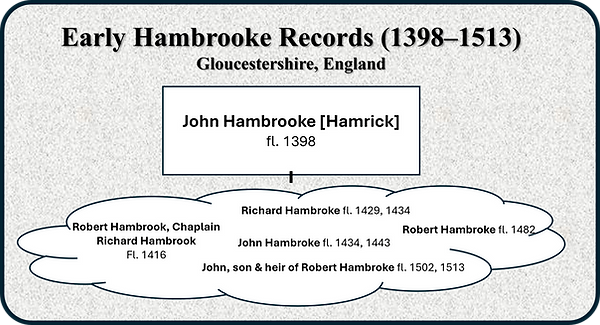
Early documented Hambrooke surname cluster within the Hambrook–Henbury parish corridor (1398–1513). “fl.” indicates documented activity (floruit), not recorded birth or death dates.
These early records establish continuity and place. What remains is to determine how they connect to Patrick himself.